
Here is a comprehensive, professionally written article based on your structured outline. It seamlessly weaves together developmental neuroscience, emotional education, and your Montessori-aligned philosophy into an engaging, cohesive narrative.
The Symphony of Development: How Brain Architecture, Resilience, and Music Shape the Learning Child
In the landscape of modern education, the intersection of developmental neuroscience and pedagogy has revealed a profound truth: learning is not a detached cognitive exercise, but a holistic, deeply emotional biological process. By understanding the intricate inner workings of the child’s brain, educators and parents can move beyond traditional rote memorization toward an environment that fosters genuine resilience. At the center of this developmental ecosystem sits an unexpected neurological catalyst: music. When we look at the brain through the lens of science, we discover that the combination of a prepared environment, emotional safety, and musical engagement forms a powerful triad for lifelong human flourishing.
I. Fundamentals of the Brain: The Architecture of Potential
To understand how a child interacts with the world, we must first look at the unique topography of the human brain. Rather than a rigid machine, the brain is better understood as a dynamic “flower of neurons”—a vast, organic network where no two configurations are exactly alike.
The Triune Structure and the Connectome
Neurologically, the brain develops sequentially, structured much like Paul MacLean’s Triune Brain model, where evolutionary layers sit one on top of the other:
- The Survival Brain (Brainstem): Controls basic autonomic functions. As developmental expert John Medina notes, the brain’s primary evolutionary directive is survival. If a child feels unsafe, higher-level processing shuts down.
- The Emotional Brain (Limbic System): Processes feelings, memory, and social connection.
- The Thinking Brain (Neocortex): Responsible for logic, language, and abstract thought.
True learning requires an interconnected connectome—a map of neural pathways where these distinct regions communicate seamlessly. For an educational experience to stick, it cannot target logic alone; it must resonate through the survival and emotional layers of the brain as well.
The Dynamic Nature of Neuroplasticity
This intricate architecture is entirely malleable due to neuroplasticity—the brain’s ability to reorganize itself by forming new neural connections throughout life. As Dr. Norman Doidge explores in The Brain Changes Itself, our minds are literally sculpted by our experiences.
Neuroplasticity operates under two primary domains: genetic (inherited) blueprinting and experience-dependent plasticity. While genetics provide the baseline framework, the external environment activates actual learning. This aligns perfectly with the concept of a prepared environment—a space designed intentionally to stimulate exploration and focus. However, the mechanism that unlocks this plasticity is entirely emotional. As the saying goes, “You can only learn what you love.” The brain operates on a “use it or lose it” principle; pathways that are emotionally charged and frequently used are reinforced, while neglected pathways are pruned away.
Ambiome and Genome: The Modern Threat
We are a product of both our genome (DNA) and our ambiome (the total collective environment surrounding us). The external environment heavily dictates neurodevelopment, a reality that becomes glaringly apparent during adolescence, where profound neural remodeling occurs independent of chronological age.
Today, the modern ambiome poses distinct risks. The saturation of rapid-fire digital images, omnipresent technology, and sensory overstimulation can fragment a child’s attention span and overwhelm their neurological baseline, making the creation of calm, focused educational spaces more critical than ever.
II. How the Brain Learns: The Neurodidactic Interface
Neurodidactics—the bridge between neuroscience and instructional practice—shifts the educational paradigm away from passive consumption toward active construction. As UNESCO has championed, modern education must move away from memorizing static facts and toward building meaning. Human experience serves as the ultimate interface; the brain merely collects raw information, but immersive experience converts that information into functional knowledge.
The DAS System: The Engine of Learning
At the heart of active learning is a neurochemical trio known as the DAS System (Dopamine, Adrenaline, Serotonin). When leveraged correctly, this cycle creates an optimal internal environment for information retention and cognitive growth:
- Dopamine (Challenge): Triggered by a novel, well-calibrated challenge. Dopamine spikes anticipation, fuels executive function, and provides the “pleasure” of pursuit.
- Action (Adrenaline): Activated through physical movement and active experimentation. Adrenaline solidifies focus and ensures the brain remains fully engaged in the task at hand.
- Satisfaction (Serotonin): Felt when the challenge is successfully navigated. Serotonin introduces a sense of calm accomplishment, happiness, and internal recognition, cementing the learning pathway.
Grounding Principles in Scientific Research
This neurodidactic framework is heavily supported by leading researchers in child development:
- John Medina (12 Brain Rules): Reminds us that movement and emotional safety are non-negotiable precursors to cognitive performance.
- Dr. Bruce Perry: Highlights how emotional development and trauma affect the brain, showing that a child cannot learn unless they are first emotionally regulated and relationally connected.
- Dr. Amanda Céspedes: Emphasizes the integration of neuropsychiatry and emotional education, advocating for environments that protect a child’s psychological well-being.
- Walter Mischel: His work on self-regulation and delayed gratification underscores that emotional control is a stronger predictor of lifelong success than native intelligence.
III. Resilience and the Emotional Brain
Because the limbic system acts as the gatekeeper to the neocortex, emotions are the absolute basis of learning. When an educational environment is rich in affection, joy, pride, and enthusiasm, the brain opens up to absorb new concepts. Educators and parents must constantly ask themselves: “What trace am I leaving in the child’s being?” To educate the emotions is to educate for life.
The Mechanics of Resilience
Resilience—the capacity to recover from adversity—is not an innate trait; it is a developable neurological skill. We build resilience by:
- Centering Learning Around the Child’s Interests: When a child is genuinely interested in a topic, they naturally push through frustration, opening deep neural pathways.
- Collaborative Learning: Working alongside peers activates positive neuroplasticity, teaching children to co-regulate and see alternative perspectives.
- Strategic Recognition: Celebrating effort rather than static intelligence activates serotonin, building healthy, sustainable self-esteem.
The Adolescent Rebirth (Ages 12–18)
In the adolescent brain, this need for emotional scaffolding peaks. Dr. Maria Montessori brilliantly described the adolescent as an “emerging social newborn.” Just as an infant is physically vulnerable, the adolescent is socially and emotionally tender. During this phase, the brain undergoes a massive structural overhaul—the prefrontal cortex is being remodeled while the emotional centers are hyper-reactive.
Consequently, social, health, and environmental risks are exceptionally high. Adolescence is flexible; its onset can be anticipated by environmental stressors, and its duration can be prolonged if proper independence is withheld. Today’s educators and parents require a updated, scientifically informed outlook that views adolescent volatility not as rebellion, but as a critical, sensitive period of identity formation.
IV. Music and the Brain: The Ultimate Cognitive Superfood
If the brain requires holistic stimulation to thrive, music is its ultimate “superfood.” While reading or calculating activates specific, localized regions of the brain, processing music activates virtually every area of the central nervous system simultaneously. It requires active memory, sustained attention, and complex motor control, linking emotion directly to information and leaving a permanent neurological impression.
Musical Components and Their Neurological Impact
Different aspects of musical expression target distinct developmental domains:
| Musical Component | Developmental Target | Neurological & Psychological Impact |
| Singing | Expression & Confidence | Helps children discover their literal and metaphorical voice, building deep internal confidence and linguistic fluency. |
| Rhythm | Coordination & Connection | Enhances psychomotor coordination, regulates non-verbal emotional states, and connects the child to primal, foundational archetypes of order and pacing. |
| Harmony | Calm & Social Unity | Soothes an overstimulated nervous system, fostering empathy, compassion, and a felt sense of shared community. |
Identity, Community, and the Montessori Method
Beyond the laboratory, music serves a profound social purpose. It functions as “breathing for the soul,” breaking down cultural, linguistic, and generational barriers. It anchors a child’s identity, connecting them to their unique history, roots, and cultural pride, while simultaneously building community. Where there is music, human beings naturally congregate and sync.
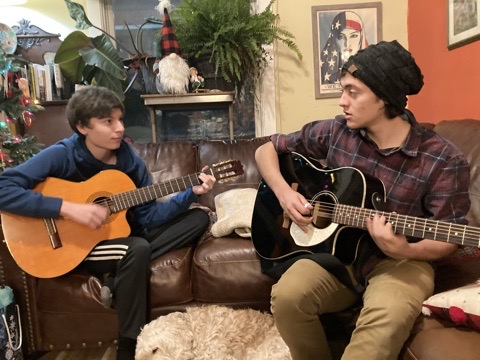
Within a Montessori pedagogical framework, music acts as a flawless tool. It beautifully mirrors the DAS system: mastering an instrument or a song presents a clear challenge (dopamine), playing or singing demands physical action (adrenaline), and performing or completing a piece delivers deep internal satisfaction (serotonin). Furthermore, music nurtures the imagination, supports early literacy and phonological awareness, and serves as a lifelong emotional sanctuary—a safe, creative space for personal resilience.
V. Synthesis: The Brain–Resilience–Music Triangle
When we synthesize these fields, a beautiful, symbiotic triangle emerges:
                       [ The Prepared Environment ]
                                    /\
                                   /  \
                                  /    \  Activates Neuroplasticity
        Fosters Emotional        /      \
           Regulation           /________\
                               /\        /\
                              /  \      /  \
                             /____\    /____\
               [ Resilience ]                  [ Music ]
                               Activates Body,
                              Emotion, & Cognition
- The Prepared Environment activates neuroplasticity, laying the structural groundwork for all future learning.
- Positive Emotions (The DAS System) act as the psychological scaffold, ensuring that learning is meaningful, joyful, and permanent.
- Music serves as the master key that activates the entire system at once—simultaneously engaging the body, elevating the emotions, and sharpening cognition.
Resilience cannot be taught through lectures or textbooks; it must be lived, felt, and practiced. Music provides the perfect, low-stakes vehicle for this journey. By feeding the child’s imagination through music, we do something far greater than teaching an art form: we sustain their hope, fortify their mind, and prepare them to navigate the complexities of the world with strength and grace.