
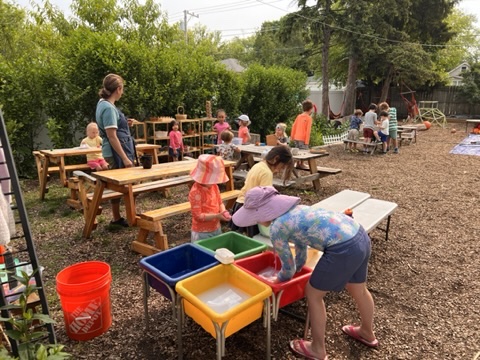
In the Montessori 3–6 Environment
I. Why Neuroscience Matters for Moral Development in 3–6
The child between three and six years old is not simply learning facts about the world. Their brain is being built — literally, structurally — and the environment around them is the architect. This is not a metaphor. It is neuroscience.
During the First Plane of Development, the child lives in what Maria Montessori called the period of the absorbent mind. The brain at this stage takes in the emotional, social, and moral atmosphere of its environment without conscious filter. It does not evaluate what it absorbs. It simply absorbs. The implications for educators and parents are profound.
Dr. Francisco Mora, one of Spain’s leading neuroeducators, puts it plainly: “You can only learn what you love.” Moral formation is no exception. Moral lessons take root only in an atmosphere of love, safety, and genuine connection. Without that foundation, instruction becomes noise.
At the center of this picture is the prefrontal cortex — the seat of executive function, self-regulation, and empathy. In the 3–6 child, this region is in its earliest stages of formation. The environments we design, the words we choose, and the behaviors we model are, in the most literal sense, shaping that structure.
The brain is not a machine that processes fixed inputs into predictable outputs. It is a living ecosystem shaped by the dynamic interaction between genetics and environment. Brain-Derived Neurotrophic Factors — proteins that support the growth and maintenance of neurons — are activated in environments that are rich, safe, and appropriately challenging. Practical Life activities and Grace & Courtesy lessons are precisely those environments. They are not curriculum add-ons. They are neurological nutrition.
II. Sensitive Periods and Moral Readiness
Montessori identified sensitive periods as windows of heightened neurological readiness for specific types of learning. During these windows, the child’s brain is undergoing active synaptogenesis — the rapid formation of new connections. Learning that happens during a sensitive period, through repetition and real experience, becomes deeply and durably embedded.
Several sensitive periods converge in the 3–6 years in ways that are directly relevant to moral formation.
The sensitive period for order means the child craves predictability and consistent social norms. This is the neurological foundation from which a sense of fairness and justice will grow. The sensitive period for movement means that purposeful, coordinated physical activity develops self-control and agency — both of which are moral capacities, not merely physical ones. The sensitive period for language means children at this age are absorbing the vocabulary of courtesy and kindness with an ease that will never come again. And the powerful drive toward social refinement — the 3–6 child’s deep need to belong, to imitate, and to align with the group — makes this the ideal moment to offer models of moral behavior.
Grace & Courtesy and Practical Life do not just take advantage of these windows. They are designed for them. Repeated, meaningful, embodied practice during a sensitive period does not produce learned behavior. It produces neurologically embedded habit — a different thing entirely.
III. Practical Life as the Foundation of Moral Development
Practical Life activities are often framed in terms of independence and fine motor development. These outcomes are real. But beneath them lies something more fundamental: Practical Life is moral education in action.
Care of self teaches dignity — responsibility for one’s own body, one’s own actions. Care of environment teaches respect for shared space and collective responsibility. Care of others develops empathy, a spirit of service, and genuine awareness of others’ needs. And the control of movement that runs through every Practical Life activity — carrying a tray without spilling, transferring water without overflowing — is impulse regulation. Impulse regulation is the neurological basis of moral choice.
Each Practical Life activity activates the sensorimotor cortex and the prefrontal cortex simultaneously. The child is not just moving their hands. They are practicing the capacity to pause, to attend, to complete — the same capacities required to choose the harder right over the easier wrong. Completing a task successfully releases dopamine along pathways linked to satisfaction and intrinsic motivation. The child who finishes sweeping the floor is not being told that helping is good. They are experiencing, chemically and neurologically, that it feels good. Repetition of these activities drives myelination — the insulation of neural pathways — in the circuits governing self-control.
Consider what is actually happening when a child prepares a snack for their friends: they are practicing generosity and awareness of others. When they carry materials carefully back to the shelf: they are practicing order as respect for community. When they clean up a spill they didn’t cause: they are practicing accountability for shared space. The moral lesson is not stated. It is lived.
IV. Grace & Courtesy: Moral Education Made Explicit
If Practical Life embeds moral capacity through action, Grace & Courtesy makes that moral capacity conscious — it gives it language, form, and social meaning.
It is important to be clear about what Grace & Courtesy is not. It is not manners imposed from the outside, rules drilled into children through correction and repetition. It is the internalization of social harmony through modeling, practice, and genuine belonging. The difference matters enormously — and neuroscience explains why.
Children at 3–6 learn social behavior primarily through observation and imitation. The mirror neuron system — the network of neurons that fires both when we perform an action and when we observe it in another — is highly active at this age. The educator’s behavior is the curriculum. The tone of voice used when a child is upset, the care with which materials are handled, the warmth extended to a visitor — these are not background details. They are lessons in progress.
Emotional security is not a prerequisite for learning that can be addressed later. It is learning, at the neurological level. Shame and fear of social rejection shut down the regions of the brain responsible for deep learning and moral reasoning. Warmth and belonging open them. Grace & Courtesy lessons succeed when the child feels invited — not corrected.
The structure of a Montessori Grace & Courtesy lesson reflects this understanding. First: name it — give language to the moral act, making the invisible visible. “This is how we greet a friend.” Second: show it — model the act slowly and with genuine warmth. This is not performance. It is activation of the mirror neuron system. Third: practice it — invite the child to try in a safe, low-stakes context. Embodied practice creates the neural pathways that observation alone cannot.
The content of Grace & Courtesy lessons spans the full range of social and moral life: greeting and farewell (recognition of the other person’s dignity); interrupting politely (impulse control combined with respect for others’ attention); offering and receiving help (interdependence, generosity, humility); saying please, thank you, and excuse me (gratitude as a moral stance, not a reflexive formula); the language of conflict resolution (empathy, listening, restorative thinking); entering a room, walking around a workspace — small acts that encode mindfulness of others as a habitual orientation toward the world.
None of these are trivial. Each one is a moral capacity being built, synapse by synapse.
V. What This Approach Actually Produces
The neuroscience is clear about what consistent, thoughtfully delivered Practical Life and Grace & Courtesy accomplishes — for the child, for the community, and beyond.
For the child: executive function develops — the capacity to plan, regulate impulses, and take the perspective of another. Internal motivation for prosocial behavior replaces fear of punishment as the driver of moral action. Emotional security enables all other deep learning. And the moral habits formed during this sensitive period, through myelinated neural pathways, become the durable architecture of adult moral life. Children who experience this approach also develop resilience — not just the ability to behave well, but the ability to repair social ruptures and continue relationships after conflict.
For the classroom community: a room rich in Practical Life and Grace & Courtesy becomes a neurologically safe environment for every child in it. BDNF — that same neurotrophic protein activated by rich, calm, stimulating environments — improves learning across all curriculum areas, not just social ones. Children who feel seen and socially competent show measurably lower stress hormone levels and higher engagement across the board.
For families: these moral habits do not stay at school. Children carry them home. And parents who understand the neuroscience behind these practices become genuine partners — able to reinforce Grace & Courtesy at home with intentionality rather than treating it as school protocol that ends at pickup.
VI. The Educator’s Responsibility
The Montessori 3–6 educator carries a responsibility that goes beyond lesson delivery. They are, in the most literal neurological sense, a co-architect of the child’s developing moral brain.
Be the model, always. Grace & Courtesy cannot be taught from the outside. It must be lived by the adult in the environment. The child’s mirror neurons are registering tone of voice, facial expression, how the educator handles conflict, how materials are treated. There is no moment when the educator is off duty as a moral model.
Prepare an emotionally safe environment. Emotional connection is the prerequisite for learning — not a nice addition to it. Safety enables curiosity, and curiosity enables moral risk-taking: the willingness to try the right thing even when it is difficult.
Deliver lessons with calm, warmth, and repetition. Moral learning at 3–6 requires embodied, repeated experience. It does not require lectures. Grace & Courtesy lessons must be offered as invitations, never corrections.
Observe before intervening. Moral readiness is real. A lesson delivered at the wrong moment produces shame; the same lesson at the right moment produces insight. The educator who observes carefully knows the difference.
Use language that builds moral agency, not compliance. The difference between “Say sorry” and “How do you think she felt? What could you do?” is not stylistic. The first bypasses the prefrontal cortex through social pressure. The second activates it. One produces performance; the other produces moral thinking.
Design Practical Life intentionally for moral outcomes. Every Practical Life activity is also a moral activity. The educator who sees it that way — who sequences activities to build independence, and understands that independence is the ground of moral confidence — is designing a moral curriculum, not just a practical one.
Attend to your own inner life. The educator’s emotional regulation matters — not as a personal virtue, but as a professional responsibility. A stressed, reactive adult activates stress responses in children that directly shut down learning and moral development. Reflective practice, self-care, and ongoing professional formation are not optional extras. They are requirements of the role.
VII. The 3–6 Years as the Moral Foundation
Moral development is not a separate track running alongside academic learning. It is learning, at the neurological level.
Practical Life and Grace & Courtesy are not soft skills included in the Montessori curriculum as a kindness to families. They are hard neuroscience: building the prefrontal cortex through purposeful action, myelinating self-control circuits through repetition, activating BDNF through environments that are meaningful, joyful, and genuinely challenging. The child who cares for plants, prepares food for friends, greets visitors with ease, and knows how to enter a conversation without interrupting is not displaying good manners. They are demonstrating a moral brain in formation — one whose architecture is being laid down right now, in these years, in these environments, through these practices.
The educator in a 3–6 Montessori environment carries enormous responsibility. And enormous power. What they provide — through the environment they prepare, the words they choose, the behaviors they model — shapes not only how children act today, but their future capacity for moral life.
That is the work. And neuroscience confirms: it matters more than we may have imagined.